2010-08-10

Beer 100724-100809

Nöel du BaladinDSC00547
Italy
ABV: 9%
Rating: 3
Sweet. Surprisingly thick body. Not very heavy but still present acidity. Strawberry notes. Bizarre.


Oppigårds Single Hop Ale DSC00551
Sweden
ABV: 4.8%
Rating: 4
Pretty low bitterness for the style but still very good hop aroma. Sweet notes of honey and some mystic spicy notes as well. Very good and drinkable.


Fastlagsgatans Nanobryggeri Det Smakar ApaDSC00565
Sweden
ABV: 6.9%
Rating: 4
Very bitter with notes of jam. Nice colour and carbonation. A little liquorice in the after-taste. A very good home-brew.


Kortedala Enskilda Hinkbryggeri Coconut Stoutcoconut_stout_etikett_small[2]
Sweden
ABV: 5.5%
Rating: 3
Oily. Weak and dry coconut aroma although it scents a lot from coconut. A little pale in taste but its body is getting rounder and more pleasant as it gets warmer.


Avery New World PorterDSC00567
USA
ABV: 6.7%
Rating: 3
Great sweet scent with heavy coffee notes. Bitter and a little rough. Unfortunately it isn’t very complex and a pretty pale standard porter.


St Landelin MythiqueDSC00568
France
ABV: 7.5%
Rating: 3
Typically French with a fresh taste of apricots.

2010-08-08

Strategy – Library size

I have hesitated writing strategy articles in this blog before since I don’t see myself as anything else than a mediocre player. But when it comes to balancing a library I think I have come pretty far in my thinking. I use to hear “I think you have built this deck as good as it is possible” from good and experienced players when they see my weirdest decks. Let’s just ignore the fact that they add “But you probably wont win any tournament with it.” for now and concentrate on the fact that one of my least weak feats in Jyhad is the ability to build a well-balanced deck.

All the time people build 90-card libraries and I am not only talking about inexperienced players, people still win tournaments with 90-card libraries all the time. So far in 2010 43/123 decks in the TWDA have 90-card libraries and quite some are close with more than 80 cards. The way I see it almost no library at all should contain 90 cards. The only exception I can think of right now is decks exploiting Guillame Giovanni’s ability to increase hand size by one for every location controlled.

So, what is the reasoning behind my thesis? A library of 90 cards is never exhausted (unless target of some serious mill tactics but in that way 90 cards doesn’t help either). The fewer cards to shuffle, the lesser risk of drawing big chunks of one type of a card at the wrong time. In other words, a 60-card library gives it’s player a more reliable distribution than a 90-card one. This is simple (maybe not so simple but still) mathematics. Still normally intelligent people and players that are better than me argue that 90 cards is the way to go. I understand the inexperienced player, I was there when I restarted playing Jyhad late 2007, in that he want so many cards and its painful enough to lower the desired deck-size to 90 cards but players constantly active since 1994? I just don’t get it.

At the summer of 2008 I started to build 60-cards libraries and my results improved a little. Problem was that I went from strict 90 to strict 60 and that is actually too few in many cases. Late 2008 I tried 70, 75 and 80 cards but it wasn’t until late 2009 I entered a tournament with a library of a number not dividable by 5. This is not important for this article but it shows how I locked myself thinking “I shall build a 60/70/75/80/90-cards deck”.

What I have been doing the last months is to try and build every deck a 60-cards deck and increase its numbers after play-testing if needed. This way I get the best possible distribution when testing and rebuilding my deck. I also know what amount of cards is right from experience of having just a handful cards left when winning a standard 5-player table. I break this rule now and then claiming to “know” that 60 cards is too few but I promise to be better following my own concept in the future. As a meaningless fact I can tell you that the 7 decks I have in my bag for the moment contains 60, 64, 70, 72, 73, 76 and 76 cards.

What to think of when building small decks? I try to study actual games to see how many cards of a certain type I actually need and not how many I want. Of course you always want to deflect every bleed that hits you but how many times do you want to have your hand size decreased by 1 for the bounce card, pay one blood to bounce and stay untapped or keep a wake at hand to be able to bounce? Maybe not as many times as you think. This is just one example that is possible to apply to many different types of cards. How many times do your combat deck actually need to play Taste of Vitae during a game and do you need a Blur in each round or is it okay to just hit for 2 with your Magnum some times?

Probably this is nothing new for most of you and stubborn players keeping every deck at 90 cards wont be convinced by reading this but hopefully there are some details in my writing worth taking into consideration for some of you.

Good luck fellow deck-shrinkers!

2010-08-01

Dynamitardens Kardemummaporter - Bottling

Three weeks ago we added cardamom and vanilla in the secondary fermentation of our porter. One week ago we also added coffee. Today it was time for bottling and we now only have to wait for about a month until it should be ready.

DSC00552 Gravity is measured and we seem to reach a pretty strong 9.7% ABV.


DSC00554 Some yeast is mixed with sugar for carbonation. The reason for using yeast is that with such a strong brew it can be hard to make sugar alone manage the carbonation process.

DSC00556 Jonas and Erik mixing the porter with sugar and yeast.

DSC00558 If nothing else, we are getting a great colour.

DSC00562 So many bottles, still so few.. We managed to fill 60 33cl bottles this time for a total of 20l.

2010-07-30

Guest brewer – Brandon Haas

I am very proud to present an article by a fellow home brewer writing about the making of his two first beer. Brandon Haas, California USA is one of the few V:tES players who also brew beer that I know of and us vampire flipping wort cookers need to stick together so here is his report accompanied by some pictures of the process:

I've been woefully negligent in publicizing my beer. So far, I've completed two batches and will be moving on to a third. I had intended to export a blog entry over to Stefan, but I've been too lazy until now. Sorry, Stefan! Here's a brief run-down of what I've done and learned so far.

Beer "Number 1"
The first batch I made was an English style bitter beer back in June. I used a recipe that I found in a beer book that seemed simple and had some help from my wife stirring, but that's about it. After a day or two, the yeast was bubbling and everything seemed pretty good. The beer did not have as high a gravity as I was looking for because I added water up to the five gallon mark, like the directions said.
For those who don't know much about making beer, gravity is the density of a liquid in comparison to water; the higher the gravity, the more sugar in the wort(pronounced "wert"). Yeast does it's magic by eating sugar and turning it into alcohol and carbon dioxide.
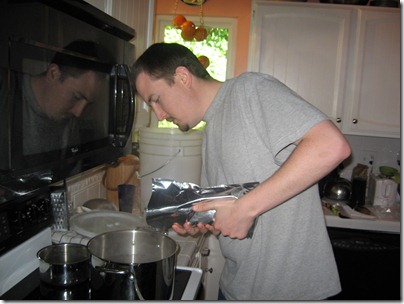
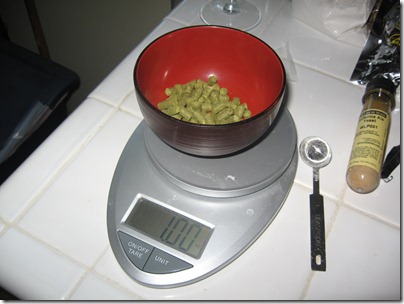
The brewing process is pretty simple. Add as close to five gallons of water to a pot(mine only fits two gallons, I have to add more water later) and bring it to a boil. Once the water boils, remove it from the heat and add your malt sugar, stirring until it dissolves. Return to heat and bring to a steady boil for an hour. Once you're ten minutes or half an hour in, add your hops. There are different methods/times for this, so follow your recipe.
beer n1 007beer n1 004beer n1 008beer n1 009

After the boil is complete, immerse the pot in water to cool it down and have the lid on to reduce the chances of wild yeast and bacteria getting to your wort. Once cool, siphon the wort to your fermentor, a bucket with an air tight lid that has an escape valve for carbon dioxide, leaving the gunk at the bottom of the pot(called "trub"). Add water to the desired gravity, then add the yeast. Beer yeast can require some preparation, so read any directions that come with it. Store in a cool place, like your basement or a dark back room. Within a few days, the yeast will start bubbling up and leave a thick layer of foam at the top. In about another week or ten days, you have un-carbonated beer.
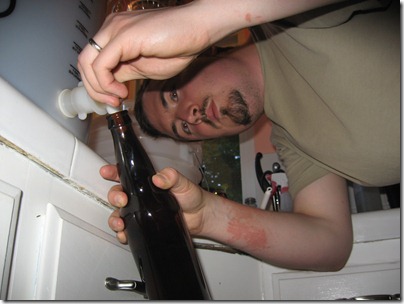
beer n1 012When the beer was done fermenting, it was also a higher gravity than I wanted, leading to a generally watery beer. Once I primed the beer, I bottled it in mostly 22 ounce+ bottles. Priming is where you add about 4 ounces of corn sugar just prior to bottling so that the left-over yeast has just enough food to carbonate the bottle, but not so much that it explodes. I gave the beer a week and a half to age, then tasted it.
beer n1 015beer n1 017beer n1 018

Number 1 could be best described as beer-like. A slight hops taste and a clean finish reminded me of maybe Coors Light, which is basically urine made by other means. Not a bad first beer. It was drinkable, which was my only real expectation.

"Sunless Summer"
It has been a very cold summer here in Aptos, the coldest in a long time I've heard. When I started this batch, I was concerned that it might get too hot, like over 75 degrees- I never had that problem. We decided on a wheat beer because that is best during hot summer days. If I ever have one, I'll have to test that theory ;)
This time, I used a dry yeast. The process was pretty similar, except that instead of just using barley malt, I steeped some wheat grain to get the sugar out of it and added that to the mix. Once things were brewed, I added water, but only enough to get me to the gravity I wanted. As a result, the beer is strong enough and more flavorful. One concern I had was that the yeast took about four days to get started, so long that I bought more yeast to try to salvage the batch. When I brought the vial home, the beer had started bubbling and it was no longer needed.
Yield was lower, about 3.5 to 4 gallons instead of about 4.5 to 5. After talking to my local home brew supplier, I may need to aerate the wort more to get the yeast started. I should also get a larger pot for brewing as I feel like I'm wasting a fair amount of the sugar and getting small yields.
Sunless Summer is kind of funky, a mix of malt and yeast flavor that could use some balance. With a slice of lemon, it tastes much more like a hefeweizen. I'm pretty proud of this batch.
The next beer I'm going to make will be a belgian. Instead of using pure malt sugar, which is somewhat expensive, I'll use some table sugar to help feed the extra wheat beer yeast I have left over. Wish me luck!

Brandon Haas
Prince of Aptos, Caifornia

2010-07-20

Beer 100706-100718

Nynäshamns Smörpundet Porter 2007DSC00525
Sweden
ABV: 6%
Rating: 4
Very fresh with great taste of chocolate. Unfortunately the nice thickness and roundness seems to have gone a little due to aging. Still a very good porter with a little oily body.


DSC00539

Hoegaarden
Belgium
ABV: 4.9%
Rating: 3
A nice wheat-beer with good citrus notes.


DSC00540

Blågul
Sweden
ABV: 5.2%
Rating: 2
Not bad for a standard budget watery lager.


DSC00541

Williams Brothers Summer Sun
Scotland
ABV: 4%
Rating: 3
Weak but pleasant hop taste. Like a good lager.


DSC00542

Anderson Valley Summer Solstice
USA
ABV: 5.6%
Rating: 3
Drinkable wheat beer with a weird bitterness. Interesting and ok.


DSC00544

Karlovacko Pivo
Croatia
ABV: 5.2%
Rating: 2
Very bitter lager with apple and lemon notes. Not very good at all.


DSC00545

Nynäshamns Bedarö Bitter
Sweden
ABV: 4.5%
Rating: 3
Flat taste but well-balanced and perfectly drinkable. Nice citrus notes.


DSC00546

Maltola Birra Red
Italy
ABV: ? (somewhere above 5% if I remember correctly)
Rating: 2
Somehow I get the feeling of weak barley wine with strong almond taste. Very malty but dull and not very rich in flavour.

2010-07-07

Westgota Nidbryggeri - Finalising Bonnatwist Bitter and brewing porter

Finally it was time for Westgota Nidbryggeri to brew again. And on top of that, Bonnatwist Bitter is finally ready and fully drinkable. Let’s start with my (fully objective) review of that one:

Westgota Nidbryggeri Bonnatwist Bitter DSC00507
Sweden
ABV: 4.5%
Rating: 4
Strong Amarillo-taste that mixes nice with the bitter style. Notes of sweet liquorice adds to the experience and it is very well-rounded and mature. A very good first brew.


As mentioned we decided to brew a porter this time. We are going to spice it up a little in secondary fermentation but lets keep those ingredients a secret until time is up for that. As you can see a lot of malt extract and later even 500 grams of sugar is needed to give the porter its character and strength:

DSC00505

We used Pearl as bitterness-hop and here is what the starting stages of the cooking looked like, after steeping some chocolate malt, adding the hops and malt extract:
DSC00513 DSC00514 After 30 minutes we added Northen Brewer hops for taste and some Irish Moss for clarity:
DSC00515 This time we didn’t make as many mistakes cooling the wort and with the help of some ice we managed to stay on the critical temperatures for a very short time:
DSC00519 As you can see the brewery is now sponsored by Luana AB and here is a group photo taken during the successful brewing session:
IMG_3390

2010-07-05

Beer 100625-100705

Nynäshamns Dragets Kanal Dubbel IPADSC00478
Sweden
ABV: 7.7%
Rating: 4
Sweet and fresh with a taste of honey. Very good hop bitterness. The biggest downside was the small bottle.


Struise Mikkeller Elliot BrewDSC00480
Belgium/Denmark
ABV: 9%
Rating: 4
Very sour and fruity, almost estry. Interesting hop bitterness, not typical for this style but it harmonises great with the fruity tastes. When it grows warmer the bitterness grows stronger. A malty after-taste appears with notes of apple. Even some citrus-notes are there. A very complex brew that deserves its rating mostly from being interesting rather than very good.

Falcon Extra BrewDSC00498
Sweden
ABV: 3.5%
Rating: 2
Pure Swedish folköl, the one you can get blind drinking. Standard lager.


Fastlagsgatans Nanobryggeri Premiere DraughtDSC00503
Sweden
ABV: 4.7%
Rating: 2
Sour apple. A little sweet also. Nice carbonation but pretty flat overall.


Kortedala Enskilda Hinkbryggeri Cascade IPADSC00506
Sweden
ABV: 5.1%
Rating: 3
Intense bitterness and good hop-taste. A little weak in carbonation and not that complex but still good.